Several Danish schools experience indoor climate challenges, and the consequences are noticeable in students' daily lives. When a classroom has too high CO2 levels or poor lighting, children's concentration and well-being decrease significantly. In fact, Danish studies show that a poor indoor climate can reduce learning capacity by up to 15 percent. A green indoor climate is therefore crucial if one wants to offer healthy conditions where all students can develop academically and socially. Here, you will gain insight into how a few changes can make a noticeable difference.
Table of Contents
Key Points
| Point |
Details |
| Green Indoor Climate |
A green indoor climate optimizes the learning environment and prioritizes students' health and well-being. |
| Key Parameters |
Monitoring air quality, temperature, noise, and lighting is crucial to ensure a healthy indoor climate. |
| Risks of Poor Indoor Climate |
Poor indoor climate can lead to health problems and reduced learning, which can affect students' long-term development. |
| Proactive Solutions |
Regular indoor climate measurements and active user involvement can create better indoor climate conditions in schools. |
What does a green indoor climate mean in schools?
A green indoor climate is about creating an optimal learning environment where students' health, well-being, and learning potential are central. It's not just about technical solutions, but about a holistic approach that combines environmental, pedagogical, and health perspectives.
According to the Danish Centre for Educational Environment (DCUM), a green indoor climate involves systematic control of key parameters such as air quality, temperature, noise levels, and lighting. These factors have a direct impact on students' concentration, health, and general well-being in the school environment.
The specific elements of a green indoor climate include:
- Optimal air exchange and CO2 regulation
- Temperature control between 20-22 degrees Celsius
- Reduced noise level below 35 decibels
- Natural and appropriate lighting
- Ongoing maintenance of building interiors
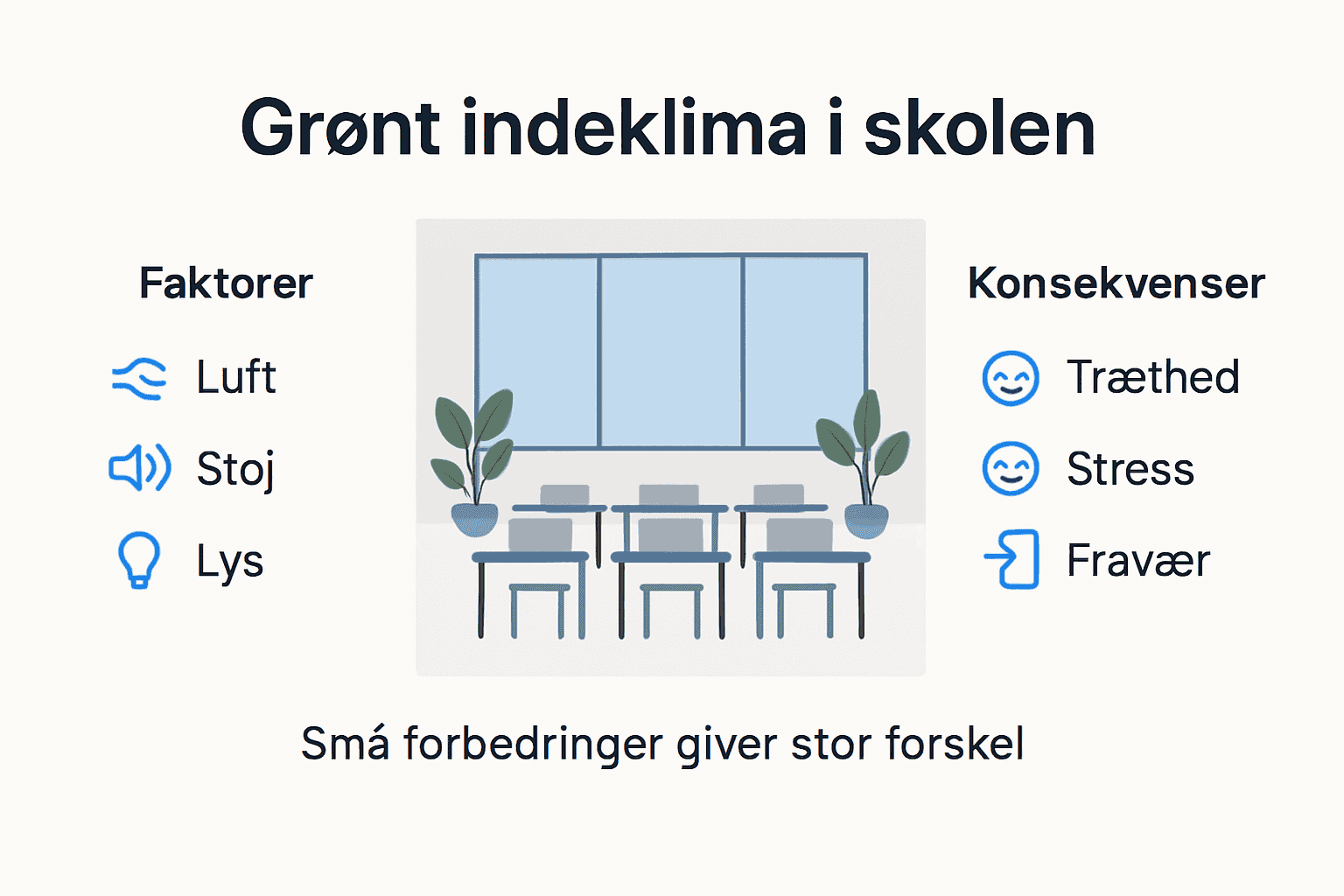
Central consequences of a poor indoor climate can be increased absenteeism, reduced learning outcomes, and general malaise among students. The Realdania report points out that children in poor indoor climate conditions can experience up to 10-15% reduced learning capacity compared to children in optimal learning environments.
Pro-tip: Conduct regular indoor climate measurements and actively involve students in identifying and improving their school environment.
The most important indoor climate parameters to know
The indoor climate in schools is complex and influenced by several crucial parameters that directly affect students' health, well-being, and learning potential. Fælles Forandring emphasizes that there are six central parameters that schools should actively monitor and optimize.
The primary indoor climate parameters include:
-
Air Quality: CO2 level, particulate and chemical concentration
-
Temperature: Optimal placement between 20-22 degrees Celsius
-
Humidity: Appropriate level between 30-50%
-
Noise and Acoustics: Reduction of disturbing background noise
-
Lighting: Sufficient daylight without glare
-
Ventilation: Efficient air exchange
According to RGO's thorough analysis, these parameters are closely linked and require a holistic approach. A poor indoor climate can lead to reduced concentration, increased fatigue, and in the worst case, health challenges for students.
Each parameter plays a crucial role: For example, high CO2 levels can quickly reduce students' cognitive performance, while inappropriate temperatures can create unnecessary unrest and inattention in the classroom. Continuous monitoring and ongoing adjustments are key to ensuring an optimal learning environment.
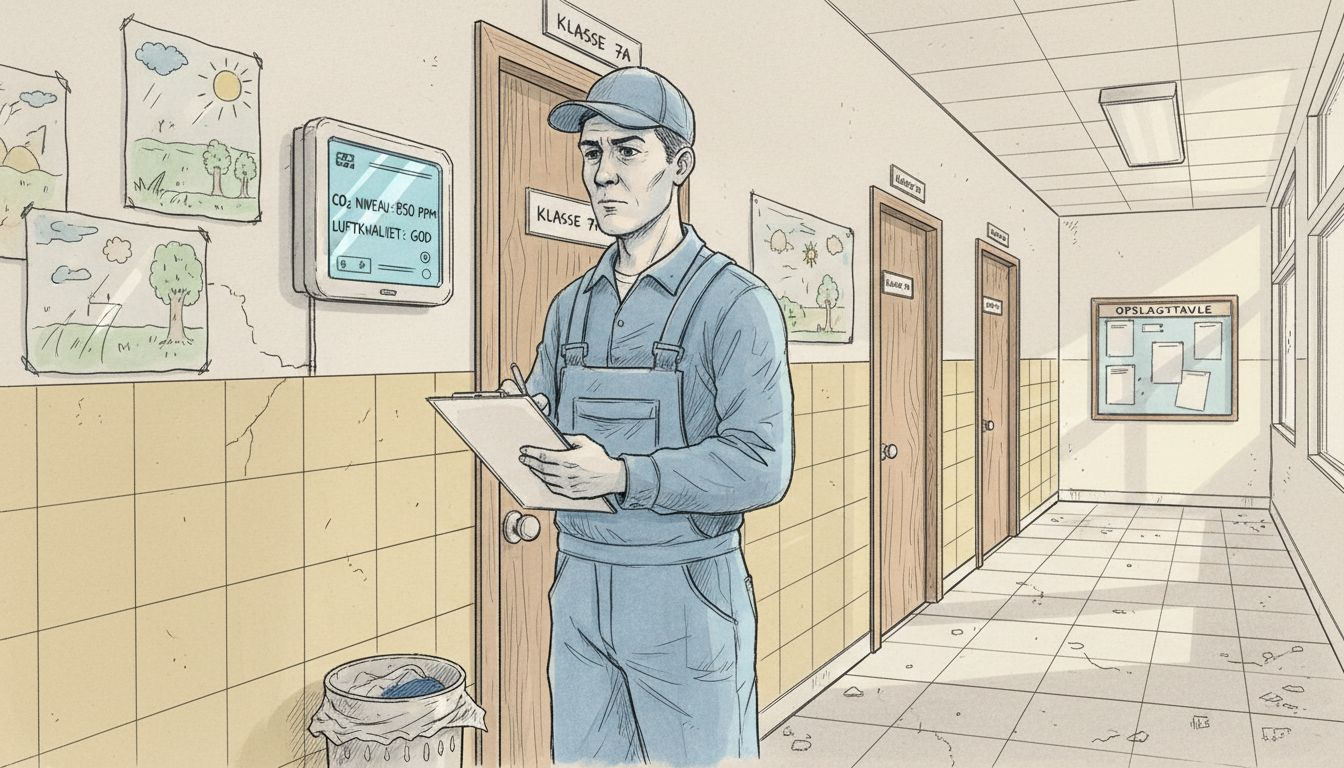
Here is an overview of how indoor climate parameters affect students' performance in school:
| Indoor climate parameter |
Direct effect |
Typical signs in students |
| Air quality |
Reduced concentration |
Headache, fatigue |
| Temperature |
Restlessness and reduced focus |
Restlessness, discomfort |
| Noise level |
Disturbed learning |
Lack of attention |
| Lighting |
Eye strain |
Tired eyes, low energy |
| Humidity |
Poor well-being |
Irritated mucous membranes |
Pro-tip: Install simple CO2 meters in classrooms and create a culture where students themselves learn to be aware of air quality.
How to achieve a healthy and green indoor climate
The Ministry of Education's guidance highlights that a healthy and green indoor climate requires a coherent strategy that combines technical solutions with active user involvement. It's not just about installing new systems, but about creating a holistic approach to indoor climate improvements.
Key strategies for achieving a healthy indoor climate include:
-
Ventilation systems: Ensure efficient air exchange
-
Temperature regulation: Maintain optimal temperature between 20-22 degrees Celsius
-
Noise reduction: Implement acoustic solutions
-
Humidity control: Keep humidity levels between 30-50%
-
User involvement: Educate and involve students and staff
Realdania emphasizes that the success of indoor climate improvements depends on close collaboration between municipalities, schools, and users. Long-term solutions require political support and a strategic approach that goes beyond immediate technical improvements.
The most effective method is to combine technical solutions with continuous measurement, evaluation, and user involvement. This includes regular air quality measurements, staff training in understanding indoor climate parameters, and creating a culture where everyone takes responsibility for the shared indoor climate.
Pro-tip: Establish a green indoor climate committee at the school with representatives from various groups, who continuously evaluate and improve the indoor climate.
Risks of poor indoor climate for students
The Danish Industry report reveals the serious consequences of a poor indoor climate, which affect students far more comprehensively than mere physical discomfort. An unhealthy school environment can significantly threaten children's long-term health and learning potential.
The main risks of poor indoor climate include:
-
Health challenges:
- Increased risk of allergies
- More frequent respiratory infections
- Worsening of asthma symptoms
-
Learning consequences:
- Reduced concentration capacity
- Faster fatigue
- Reduced cognitive performance
Synergiorganisation's studies show that high CO2 levels, noise, and inappropriate temperatures can lead to significant negative effects. These factors not only affect students' immediate well-being but can potentially create long-term health and educational challenges.
The psychosocial aspects are equally concerning. Students in a poor indoor climate experience more frequent stress, find it harder to engage in lessons, and can develop a negative attitude towards the schooling process itself. This emphasizes the importance of viewing indoor climate as a fundamental part of children's overall well-being and learning potential.
Pro-tip: Encourage the school board to conduct regular indoor climate assessments and make the results visible to parents and students.
Typical mistakes and effective solutions in practice
The Realdania example collection identifies a number of central challenges and solution strategies for school indoor climates, which require a systematic and holistic approach.
Typical errors in school indoor climates include:
-
Ventilation problems:
- Insufficient air exchange
- Lack of maintenance of ventilation systems
- Incorrect placement of ventilation systems
-
Temperature and humidity imbalances:
- Uneven temperature distribution
- High or low humidity levels
- Inadequate temperature regulation
Godt Arbejdsmiljø's analysis emphasizes the importance of systematic data collection as a basis for effective improvements. Solution strategies should include:
- Installing modern, energy-efficient ventilation systems
- Combining mechanical and natural ventilation
- Implementing sound-absorbing materials
- Using simple measuring instruments for continuous monitoring
The most effective approach is to create a culture change where leaders, teachers, and students actively participate in improving and maintaining a healthy indoor climate. This requires continuous education, openness to change, and a shared understanding of the importance of the indoor climate.
Below, typical mistakes and effective solutions for indoor climate in schools are compared:
| Challenge |
Most common cause |
Recommended solution |
| Poor ventilation |
Lack of maintenance |
System upgrade |
| Uneven temperature |
Poor regulation |
Modern control |
| High noise level |
Lack of acoustic materials |
Sound-absorbing panels |
| Incorrect humidity |
Ineffective ventilation |
Adjustment of ventilation |
Pro-tip: Initiate an indoor climate ambassador program where selected students are trained to identify and report indoor climate challenges.
Create a Green Indoor Climate with Precise Measurements and Active Efforts
A poor indoor climate in schools causes fatigue and reduced concentration in students. To achieve a green and healthy indoor climate, it is crucial to have full control over parameters such as CO2, temperature, and noise level. Through active measurement and continuous monitoring, you can ensure optimal air quality and well-being, so students have the best conditions for learning.
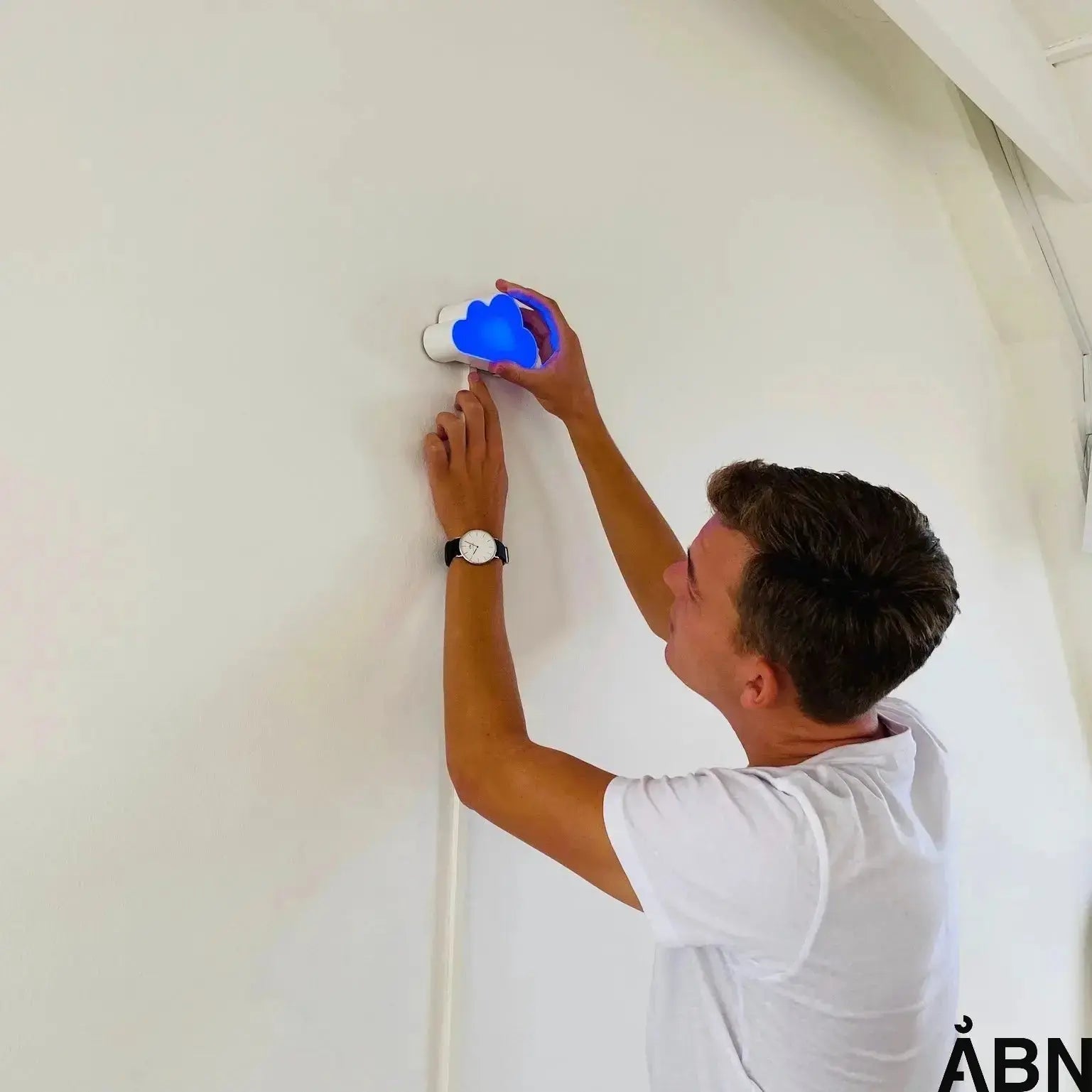
With us, you'll find user-friendly sensors and measuring instruments like Skyen, which make it easy to monitor and improve the indoor climate in your school. Don't wait to act on your words. Experience how technology and knowledge go hand in hand to make the school environment green and healthy. Visit https://aabn.io/products/skyen and get an easy start on smarter indoor climate solutions today.
Frequently Asked Questions
What is a green indoor climate in schools?
A green indoor climate in schools focuses on creating an optimal learning environment by improving air quality, temperature, noise levels, and lighting, which contributes to students' health and well-being.
Which parameters affect the indoor climate in schools?
The primary indoor climate parameters include air quality, temperature, humidity, noise, lighting, and ventilation. Each of these factors affects students' concentration and general well-being.
How can the indoor climate in schools be improved?
Improvements can be achieved by ensuring efficient ventilation, adjusting temperatures between 20-22 degrees Celsius, reducing noise levels, controlling humidity, and involving students and staff in indoor climate improvements.
What are the consequences of a poor indoor climate for students?
A poor indoor climate can lead to increased absenteeism, reduced learning outcomes, headaches and fatigue, as well as exacerbate allergies and asthma symptoms, ultimately affecting students' well-being and learning capacity.
Recommendation