Cart
0
Help for optimizing the indoor climate




Up to 30 percent of Danish schoolchildren experience reduced concentration due to poor indoor climate. When teaching premises are not kept clean and well-ventilated, it significantly affects both health and learning. For you as a school leader, it's about more than just a healthy environment; it's also about creating optimal conditions for well-being and results. Here, you'll gain insight into how cleaning directly strengthens students' daily lives and school environment.
| Point | Details |
|---|---|
| Importance of cleaning | Cleaning is crucial for ensuring a healthy indoor climate, which directly impacts students' learning and well-being. |
| Effective cleaning strategy | Implementing a systematic cleaning strategy can reduce allergens and improve air quality. |
| Collaboration and responsibility | Close cooperation between school management, cleaning staff, teachers, and parents is necessary to maintain high hygiene standards. |
| Environmentally friendly approach | Choosing eco-labeled cleaning products is essential to meet legal requirements and ensure sustainability in cleaning methods. |
Cleaning plays a crucial role in the indoor climate of schools, where children and young people spend a large part of their day. The school environment directly affects students' health and learning through air quality, temperature, and cleanliness. A thorough and systematic cleaning strategy can reduce the occurrence of allergens, dust, and microorganisms, thereby improving the overall indoor climate.
Temperature and ventilation are central elements of the indoor climate in schools. Climate conditions in public buildings have a direct impact on productivity and well-being, especially in educational environments. Cleaning processes not only help remove visible dirt but also control humidity, reduce dust levels, and create a healthier environment for both students and teachers.
An effective cleaning strategy should include:
Professional tip: Implement a systematic cleaning program with clear guidelines and continuous training for cleaning staff to ensure consistently high hygiene standards.
Schools' cleaning strategies are crucial for maintaining a healthy indoor climate. The Danish Health Authority recommends specific hygiene standards, which are essential for preventing the spread of infection and ensuring a healthy environment for children and young people. There are different types of cleaning, each with its specific role in maintaining the indoor climate of schools.
Preventive cleaning involves daily maintenance and includes:
Thorough cleaning is typically performed after school hours or during holidays and includes more intensive cleaning such as:
School health projects such as Schools4Health emphasize the importance of integrated hygiene standards that focus not only on cleaning but also on prevention and health promotion.

Professional tip: Implement a digital cleaning schedule with checklists and allocation of responsibilities to ensure consistent and systematic cleaning quality.
Here is an overview of how different cleaning types contribute to a healthy school environment:
| Type of cleaning | Primary effect | Relevance for indoor climate | Effect on health |
|---|---|---|---|
| Preventive | Removes daily dirt | Reduces allergens and dust | Decreases risk of illness |
| Thorough | Deeper hygiene | Optimizes air quality | Increases well-being and concentration |
| Environmentally friendly | Minimizes chemicals | Lowers environmental impact | Improves respiration and well-being |
Schools' cleaning methods directly influence air quality, which critically affects students' health and learning potential. Cleaning not only removes visible dirt but also reduces invisible airborne particles such as dust, allergens, and microorganisms that can degrade the indoor climate.
The Danish Building Regulations specify standards for air quality. Ventilation systems must keep the CO2 concentration below 1000 ppm, which requires continuous cleaning and maintenance of premises and ventilation systems. Dust removal, thorough cleaning of surfaces, and regular ventilation are crucial for maintaining healthy air quality.
The impact of cleaning on air quality can be divided into the following key areas:
Professional tip: Choose eco-friendly cleaning products with low volatile organic compounds (VOC) to reduce chemical fumes in the classroom.
The impact of the school environment on students' well-being and learning potential is deeply connected to the quality of the indoor climate. A clean and well-maintained school environment not only reduces the risk of disease spread but also improves the mental and physical health of children and young people.
Research shows that a healthy indoor climate is directly linked to students' concentration abilities and academic performance. School health projects document how improved environmental conditions can reduce social inequalities and promote educational success, emphasizing the importance of systematic cleaning and maintenance.
The most significant connections between cleaning, health, and learning include:
Professional tip: Conduct regular well-being surveys to document the correlation between indoor climate and student performance.
Danish environmental legislation sets increasingly stringent requirements for cleaning methods in public institutions. The updated Nordic ecolabeling criteria oblige cleaning companies to use at least 90% environmentally friendly products, ensuring a sustainable and health-friendly approach to school cleaning.
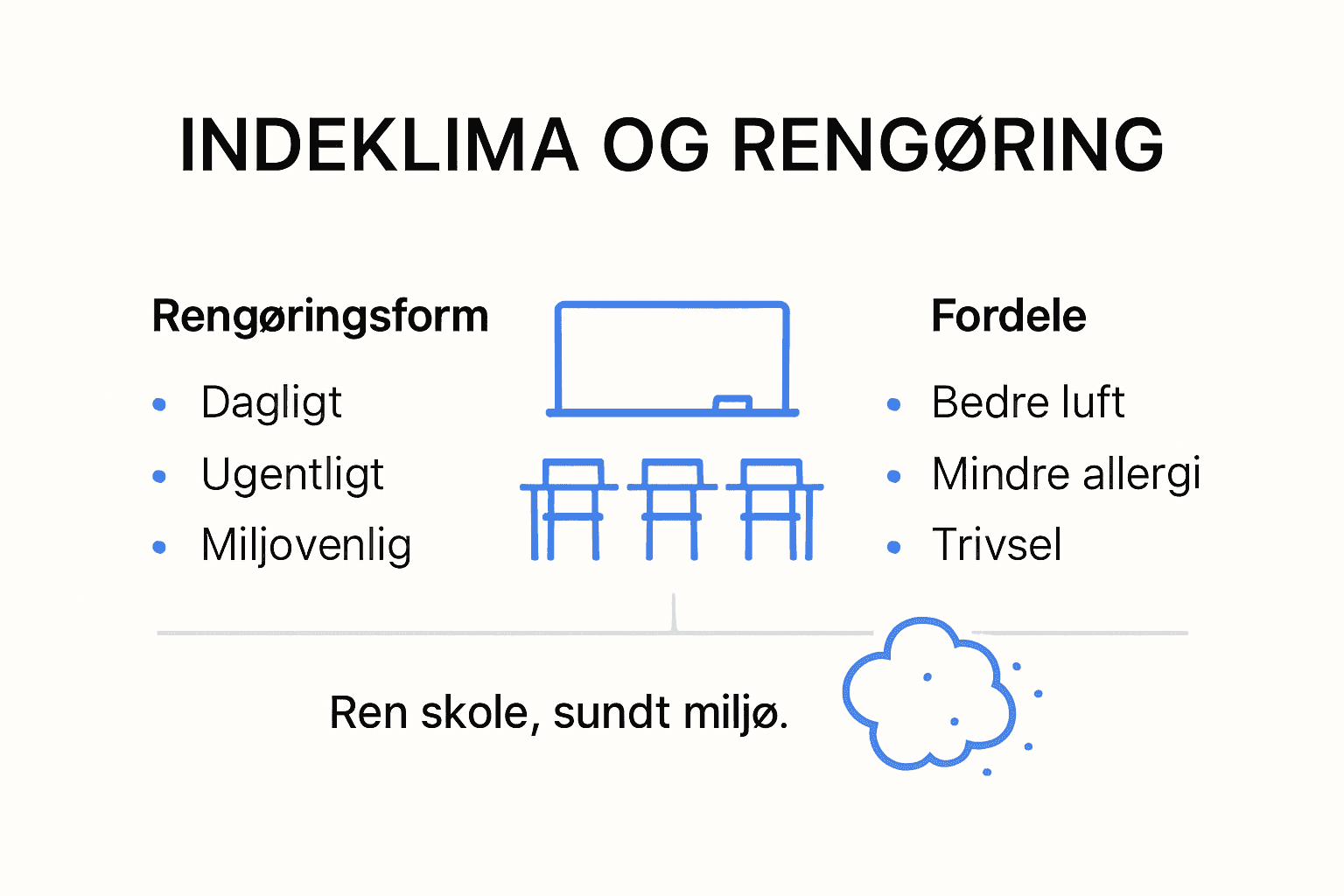
Environmental legislation in Denmark emphasizes the importance of sustainable cleaning practices, which focus on reducing the use of harmful chemicals and promoting resource efficiency. This legislation aims to create healthier indoor environments while minimizing ecological impact.
The central principles of environmentally friendly cleaning include:
Professional tip: Introduce annual environmental certifications to ensure continuous compliance with the latest sustainability standards.
The provisions of the Primary and Lower Secondary Education Act establish the clear responsibility of the school leader to ensure a healthy indoor climate and effective cleaning. This responsibility involves close cooperation between school management, cleaning staff, teachers, and parents to maintain high hygiene standards.
Guidelines for educational institutions emphasize the importance of coordinated efforts between municipalities, education providers, and caretakers to prevent errors in cleaning processes and ensure a healthy school environment.
Mistakes to avoid in schools' cleaning strategies include:
Professional tip: Establish a quarterly audit system where cleaning quality and allocation of responsibilities are systematically reviewed and evaluated.
The table summarizes the most important legal requirements and responsibilities in school cleaning:
| Legal Requirement | Responsible Party | Control Method | Purpose |
|---|---|---|---|
| Ecolabelling of products | Cleaning provider | Annual third-party inspections | Ensure sustainable practices |
| Maintenance of air quality | School leader | Measurement of CO2 and humidity | Healthy learning environment |
| Staff training | School management | Internal training and audits | Consistent hygiene standard |
The importance of cleaning for a healthy and safe indoor climate in schools cannot be underestimated. The article clearly demonstrates the challenges school leaders and cleaning staff face in ensuring correct air quality, preventing allergens, and creating the best learning environment for students. A lack of overview of parameters such as CO₂, humidity, and chemical fumes makes it difficult to achieve the necessary hygiene standards and enhance students' well-being and concentration.
At Aabn.io, you will find intelligent sensors and user-friendly measurement tools that give you full insight into the school's indoor climate. With easy access to data on TVOC, temperature, sound, and air quality, the school can act precisely and effectively to optimize cleaning, ventilation, and the daily environment. Create a fresher and healthier teaching environment by using our solutions, developed with a focus on the needs of primary and lower secondary schools.
Take responsibility for your students' health and learning environment today. Visit Skyen products and experience how advanced indoor climate measurement can revolutionize your school. Ensure your school the best foundation for well-being and learning by integrating modern cleaning and indoor climate solutions now.
Cleaning is crucial for improving the indoor climate in schools, as it removes dust, allergens, and microorganisms, leading to better air quality and health.
Cleaning methods such as vacuuming, wiping surfaces, and regular ventilation remove invisible particles and pollution, thereby maintaining high air quality and contributing to a healthier learning environment.
Effective cleaning strategies include regular thorough cleaning, control of ventilation systems, and the use of environmentally friendly cleaning products to minimize chemical fumes.
Schools can ensure proper training of cleaning staff by implementing a continuous training program, offering instruction on specific hygiene standards, and regularly evaluating cleaning quality.