Cart
0
Help for optimizing the indoor climate




Suddenly, most facility managers in Danish schools and municipal institutions are facing completely new demands regarding both comfort and health. The indoor climate is becoming a central point with a direct impact on well-being and learning, because the DGNB standard for 2025 focuses on social quality and the prevention of harmful substances, poor lighting, and high noise levels. This article provides insight into how the new indoor climate standards shape the work and points to practical opportunities for improvements.
| Point | Details |
|---|---|
| Indoor Climate Standards 2025 | These standards improve human well-being by ensuring optimal indoor climate parameters in buildings. |
| Key Parameters | Focus on air quality, temperature, light, acoustics, and chemical substances is essential for health. |
| Requirements for Schools and Institutions | New requirements must be implemented to ensure energy optimization and a healthy learning environment. |
| Compliance and Documentation | A structured approach to compliance with laws and documentation is necessary to ensure high indoor climate quality. |
The indoor climate standards for 2025 represent a decisive milestone in sustainable construction and human health. These standards have a clear and important purpose: to ensure optimal physical environmental conditions in buildings where people spend most of their time.
The main purpose of new indoor climate standards is to create healthy and comfortable indoor environments that actively protect citizens' well-being. The standards focus on several critical parameters:
The technical definitions are based on the building regulations and are expanded with performance-based criteria. Indoor climate is defined as the sum of physical environmental factors that affect human well-being and health in enclosed spaces.
The standards themselves are based on thorough scientific studies and have three central dimensions:
The social quality in buildings thus becomes a crucial parameter, where human well-being is at the center.
Pro-tip: Always involve expert professionals early in the construction process to ensure optimal implementation of indoor climate standards.
Indoor climate parameters are crucial for human health, well-being, and productivity in various institutional environments such as schools, offices, and municipal buildings. Modern indoor climate studies identify several key factors that affect our daily well-being.
The main parameters include the following critical areas:
Each parameter plays a significant role in the overall indoor climate. Air quality is particularly important, as poor ventilation can lead to increased absenteeism and reduced ability to concentrate. CO2 levels above 1000 ppm can already lead to significant drops in cognitive performance.

The health significance of these parameters is extensive. The Danish Health Authority's guidelines emphasize that poor indoor climate can result in:
Here is an overview of how key indoor climate parameters affect different building types:
| Building Type | Air Quality Challenges | Lighting Conditions Requirements | Acoustic Comfort Priority |
|---|---|---|---|
| Schools | Frequent CO2 accumulation | Natural daylight important | Noise from classrooms |
| Offices | VOCs from equipment and people | Artificial lighting widespread | Open-plan offices |
| Municipal Buildings | Particle pollution from outside | Varying light incidence | Noise from activities |
Optimal indoor climate is not just about comfort, but about fundamental health protection.
Complex interrelationships between these parameters require systematic monitoring and continuous adjustment to ensure a healthy environment.
Pro-tip: Use digital sensors for continuous monitoring of indoor climate parameters, which provides precise data for ongoing improvements.
New indoor climate standards for 2025 place significant demands on Danish schools and municipal buildings with a complex focus on energy optimization and air quality. These requirements represent a comprehensive approach to improving the physical environment for children and employees.
The main requirements include the following critical areas:
The new standards set specific technical requirements for public institutions. Indoor climate quality becomes a central concept, focusing on the following parameters:
The school environment of the future is not just about education, but about creating healthy, inspiring learning environments.
The industry guideline for indoor climate emphasizes that these requirements are not just recommendations, but mandatory guidelines that must be systematically implemented in all public buildings.
Economic and practical consequences will be significant for municipalities and educational institutions, requiring strategic planning and investments in new technological solutions.
Pro-tip: Involve technical experts early in the process to ensure a cost-effective and future-proof implementation of the new indoor climate requirements.
Implementing indoor climate measurements requires a systematic and technical approach that focuses on precise data collection and analysis. Modern indoor climate measurements are not just about recording numbers, but about creating a holistic picture of the physical environment.
The main implementation methods include the following central processes:
Practical implementation typically follows these steps:
Successful indoor climate measurement is about precision, continuity, and professional interpretation.
University courses in indoor climate measurement emphasize the importance of accounting for measurement uncertainty and documenting the reliability of the results. Measurement uncertainty is a critical concept that can affect the overall assessment of the indoor climate.
Technical experts recommend an integrated approach where digital sensors are combined with systematic data analysis to achieve the most reliable results.
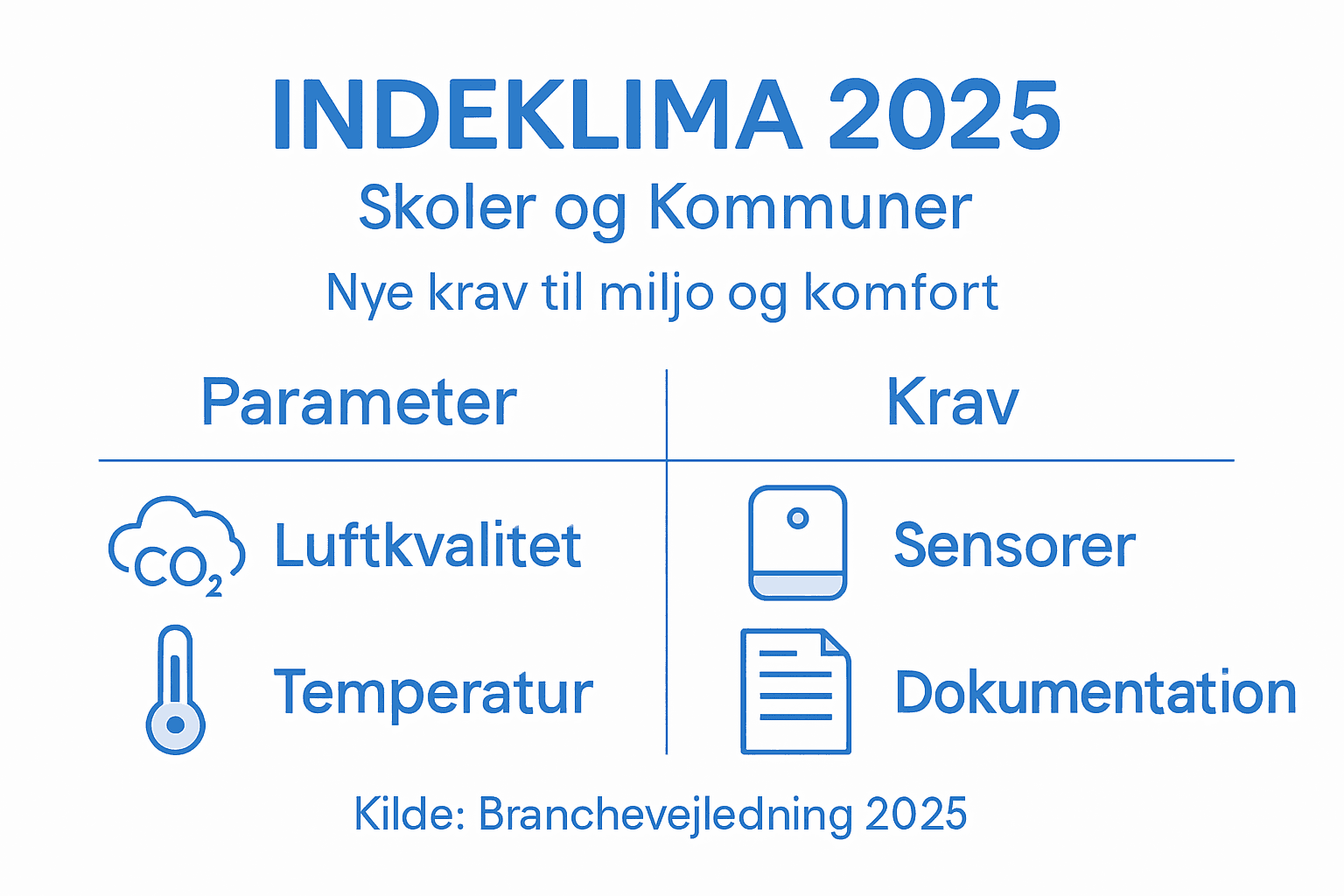
Pro-tip: Install sensors with varied placement to ensure a representative picture of the entire building's indoor climate.
Here is a comparison of indoor climate measurement methods and their strengths:
| Measurement Method | Precision | Suitable for continuous monitoring | Assessment of complex environment |
|---|---|---|---|
| Digital sensors | Very precise | Yes, real-time data can be collected | Strong in dynamic conditions |
| Manual measurements | Depends on the technician | Limited, spot measurement | Weak in variable conditions |
| Time-based analysis | Precise over time | Yes, with long-term monitoring | Good for identifying trends |
The Danish Building Regulations BR18 form the legal basis for indoor climate requirements in Danish institutions. This set of rules defines the legal framework and places clear responsibility on builders and planning stakeholders.
The main areas of responsibility include:
The compliance process involves several critical steps:
Compliance is not just about regulatory adherence, but about creating healthy and safe environments.
Danish Indoor Climate Labelling plays a central role in harmonizing national and international standards. The certification process thus becomes a crucial tool for ensuring and documenting indoor climate quality.
Technical experts emphasize the importance of a proactive approach, where legislation is seen as an opportunity for continuous improvement rather than an administrative burden.
Pro-tip: Create a systematic annual cycle for regulatory compliance to ensure continuous updating and implementation of new requirements.
Indoor climate projects involve several potential pitfalls that can compromise the air quality of buildings and the general well-being of occupants. Understanding and preventing these mistakes are crucial for ensuring a healthy indoor climate.
Typical critical errors include:
The most common mistakes can be prevented through the following strategies:
Prevention is about proactive action, not just reactive management.
Indoor climate documentation shows that material emissions can pose a significant health risk if not systematically controlled. The accumulation of harmful substances can lead to serious health consequences.
Technical experts recommend a holistic approach, where prevention is integrated into the entire building design rather than being treated as an isolated problem.
Pro-tip: Conduct regular indoor climate inspections and use certified experts to assess potential risk factors.
Indoor Climate Standards 2025 place significant demands on Danish institutions regarding documented air quality, temperature, light, and noise levels. Many organizations face challenges with continuous monitoring and precise data collection, which are necessary to ensure health, comfort, and compliance with legislation. These critical indoor climate parameters require innovative and user-friendly measuring instruments that make complex implementation manageable and credible.
At aabn.io, you will find advanced sensor solutions designed precisely for this challenge. With products like Skyen, your institution can easily monitor CO₂, TVOC, humidity, temperature, light, and sound in real-time. This means better decision-making for effectively optimizing the indoor climate, protecting students and employees, and simultaneously complying with indoor climate standards for 2025.
Take control of the indoor climate today and avoid the typical mistakes of insufficient measurement and documentation. Utilize our professional advice and measuring equipment to ensure a healthy and productive institution. Visit https://aabn.io/products/skyen and start creating inspiring, safe environments for everyone in your building.
The purpose of the indoor climate standards for 2025 is to ensure healthy and comfortable indoor environments that protect citizens' well-being by focusing on air quality, temperature, lighting conditions, and acoustics.
Indoor climate standards impose requirements on energy efficiency, ventilation systems, material usage, and continuous monitoring of the indoor climate, thereby improving the physical environment for both students and employees.
The most important indoor climate parameters include air quality, thermal comfort, acoustic environment, lighting conditions, and chemical composition, all of which are important for human well-being.
Implementation requires systematic mapping of indoor climate parameters, selection of measuring equipment, continuous data collection, and analysis of the results against applicable standards.